Solitary confinement
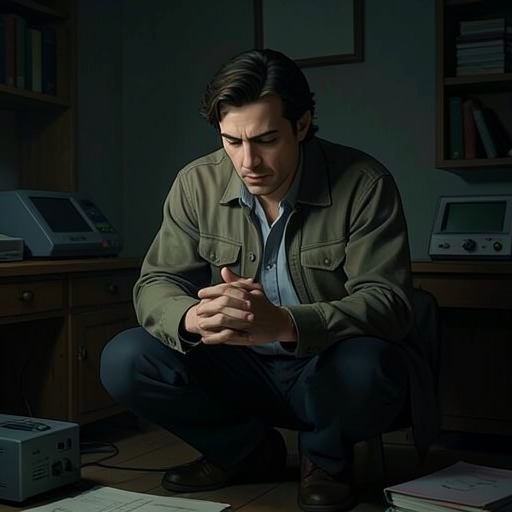
The RoomSolitary confinement is not described simply as a punishment or a place apart. For the Unnamed prisoner and defendant, being locked alone in a small cell reshapes ordinary perception: corridor signs become objects of sustained attention, changes in lighting unsettle his sense of what is bright, and hours can feel both endless and already gone. The cell confines his movement, while the rhythms and procedures of The prison make private time difficult to distinguish from institutional time.
Definition and Conditions
During testimony, the Unnamed prisoner and defendant clarifies that his cell was not precisely what other prisoners called the hole. He had been placed in a locked cell measuring nine by six feet in the tuberculosis-suspect section of The prison. He explains that being locked alone in a room of any size was an experience in itself, and that he nevertheless survived it. The distinction matters: the account identifies a particular form of isolation without claiming that it was the jail’s conventional punitive isolation unit.
The cell’s limits are registered through its immediate surroundings. At night, he watches the corridor through the small window and makes out a wall about seven feet away. He repeatedly reads the labels above baskets for dirty linen, moving from the middle of the window to one side to decipher the last signs. Shirts and pants are easy to read; hand towels, blankets, and bath towels take more effort. He checks the sequence again even though he is already confident he has read it correctly. In the absence of a wider field of activity, the effort of reading these signs becomes an event in itself.
The cell’s mirror and night light furnish another narrow routine. He examines a small blemish on his cheek, considers squeezing it, then stops because he expects that to bruise the skin. Later, he returns to it, tests its tenderness, and watches for it to change. The attention is not presented as a medical problem; it shows how confinement directs scrutiny toward details that might otherwise pass unnoticed. Meanwhile, the room seems almost as bright at night as it does in daytime. He recognizes that his eyes have adjusted, but this understanding does not settle the experience: when the ceiling lights come on, they will seem overwhelming until his eyes adjust again. Each apparent certainty is temporary, replaced by another adjustment.
Routine and the Passage of Time
The prisoner cannot use sleep as a reliable measure of time. He is not tired enough to sleep, regrets having napped earlier, and has nothing to read that might tire his eyes. Whether he sleeps at night or during the day seems immaterial; the same twenty-four hours must still pass. He recalls the childhood expectation that falling asleep on Christmas Eve would bring morning, but even then sleep was difficult. The memory offers a contrast, not an escape: waiting for time to pass was hard even when morning promised something to anticipate.
In the cell, time can drag with oppressive weight or seem to vanish. He imagines sleep as a way to make the hours pass faster, but recognizes that sleeping for a long stretch would only lead back to another day of waiting. The thought turns into a recurring loop: sleep, wake, and face the next interval. He extends his frustration to people who spent their lives tracking the stars and calculating where planets would be thousands of years later. Their calculations, in his view, cannot change the human condition of ending up where one began. This bleak conclusion echoes the cell’s routine, where time passes without producing a clear sense of progress.
Meals and occasional showers mark the day, but they do not restore a dependable sense of its divisions. The lights remain on, and he says that the time of day has become meaningless; daytime is distinguishable chiefly because it is noisier. After waking, he initially cannot tell how long he slept, then returns to the same conclusion that time makes little difference. The institutional schedule continues, but its repeated meals, showers, lights, and noise do not amount to a personal sense of movement through the day.
Institutional Control and Confinement
A trip to Courtroom shows how the institution extends beyond the cell while preserving the experience of waiting. The guard wakes him and gives him prison clothes for court. He remembers being awakened at about 5:30 and returning after 7:30, a day that lasted fourteen hours, although its details can be reviewed in only a few minutes. He waits on a bench, is taken by elevator to holding tanks, waits for clothes, is chained for transport by bus, and passes through further holding areas at the courthouse and jail. Movement between places does not mean freedom of action: each stage is organized around waiting, transfer, and restraint.
That contrast between duration and recollection sharpens the account of isolation. At the time, the court day seems endless; afterward, its sequence can be recounted quickly. In the cell, by comparison, there may be no event to divide one stretch from the next. The Unnamed prisoner and defendant therefore measures his surroundings and revisits small observations, while the institution determines when he moves, where he waits, and when he returns. His complaint about the ineffective ventilation vents belongs to this same setting: smoke hangs in the small room despite the vents, and he resents being confined there. He throws the cigarette into the commode, then imagines exposing the police department and jail system. The imagined campaign gives form to his anger, but it does not change his immediate circumstances: he lies down on the bunk and closes his eyes.
Perception, Crisis, and the Cell Door
The account also shows isolation changing the scale and reliability of perception. In a later episode, the corridor seems too bright and too wide, and he fears that he cannot make his way along it without falling. He imagines narrowing the passage or using its walls for support. His attempts to close his eyes fail because he nearly falls; he becomes acutely aware of the floor, its marks, the doorways, signs, other people, and lights. The corridor is no longer merely the space beyond his cell. It is an overwhelming route that his body must cross while he feels exposed to light and watching eyes.
Against that disorientation, the shut cell door becomes a boundary he can trust. He hears it close and takes comfort in the fact that he is safe. He studies the heavy steel door, its thick wire-mesh window, and the bolt that has been shot into place. Beyond it are baskets, signs, people, rooms, and corridors, but the locked door separates him from them. That reassurance is deliberately limited: the same barrier that protects him also keeps him confined. Solitary confinement thus gathers the account’s central tensions into one object. The door secures a private space, yet that space is where time stalls, attention circles, and the prisoner’s world contracts to what can be seen and heard from inside.